Cell division is the process by which new cells are formed for growth, repair, and replacement in the body. This process includes division of the nuclear material and division of the cytoplasm. All cells in the body (somatic cells), except those that give rise to the eggs and sperm (gametes), reproduce by mitosis. Egg and sperm cells are produced by a special type of nuclear division called meiosis in which the number of chromosomes is halved. Division of the cytoplasm is called cytokinesis.
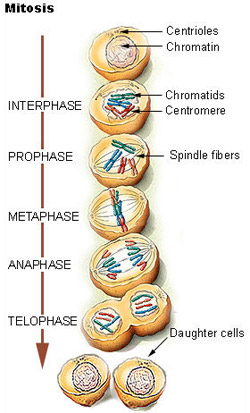
Somatic cells reproduce by mitosis, which results in two cells identical to the one parent cell. Interphase is the period between successive cell divisions. It is the longest part of the cell cycle. The successive stages of mitosis are prophase, metaphase, anaphase, and telophase. Cytokinesis, division of the cytoplasm, occurs during telophase.
Meiosis is a special type of cell division that occurs in the production of the gametes, or eggs and sperm. These cells have only 23 chromosomes, one-half the number found in somatic cells, so that when fertilization takes place the resulting cell will again have 46 chromosomes, 23 from the egg and 23 from the sperm.
Leave a Reply