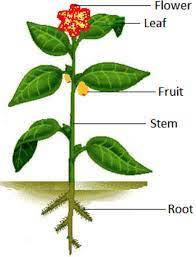
Leaf, in botany, any usually flattened green outgrowth from the stem of a vascular plant. As the primary sites of photosynthesis, leaves manufacture food for plants, which in turn ultimately nourish and sustain all land animals. Botanically, leaves are an integral part of the stem system. They are attached by a continuous vascular system to the rest of the plant so that free exchange of nutrients, water, and end products of photosynthesis (oxygen and carbohydrates in particular) can be carried to its various parts. Leaves are initiated in the apical bud (growing tip of a stem) along with the tissues of the stem itself. Certain organs that are superficially very different from the usual green leaf are formed in the same manner and are actually modified leaves; among these are the sharp spines of cacti, the needles of pines and other conifers, and the scales of an asparagus stalk or a lily bulb.
Leaf function
The main function of a leaf is to produce food for the plant by photosynthesis. Chlorophyll, the substance that gives plants their characteristic green colour, absorbs light energy. The internal structure of the leaf is protected by the leaf epidermis, which is continuous with the stem epidermis. The central leaf, or mesophyll, consists of soft-walled, unspecialized cells of the type known as parenchyma. As much as one-fifth of the mesophyll is composed of chlorophyll-containing chloroplasts, which absorb sunlight and, in conjunction with certain enzymes, use the radiant energy in decomposing water into its elements, hydrogen and oxygen. The oxygen liberated from green leaves replaces the oxygen removed from the atmosphere by plant and animal respiration and by combustion. The hydrogen obtained from water is combined with carbon dioxide in the enzymatic processes of photosynthesis to form the sugars that are the basis of both plant and animal life. Oxygen is passed into the atmosphere through stomata—pores in the leaf surface.
Leaf morphology
Typically, a leaf consists of a broad expanded blade (the lamina), attached to the plant stem by a stalklike petiole. In angiosperms leaves commonly have a pair of structures known as stipules, which are located on each side of the leaf base and may resemble scales, spines, glands, or leaflike structures. Leaves are, however, quite diverse in size, shape, and various other characteristics, including the nature of the blade margin and the type of venation (arrangement of veins). When only a single blade is inserted directly on the petiole, the leaf is called simple. The margins of simple leaves may be entire and smooth or they may be lobed in various ways. The coarse teeth of dentate margins project at right angles, while those of serrate margins point toward the leaf apex. Crenulate margins have rounded teeth or scalloped margins. Leaf margins of simple leaves may be lobed in one of two patterns, pinnate or palmate. In pinnately lobed margins the leaf blade (lamina) is indented equally deep along each side of the midrib (as in the white oak, Quercus alba), and in palmately lobed margins the lamina is indented along several major veins (as in the red maple, Acer rubrum). A great variety of base and apex shapes also are found. The leaf may also be reduced to a spine or scale.
Veins, which support the lamina and transport materials to and from the leaf tissues, radiate through the lamina from the petiole. The types of venation are characteristic of different kinds of plants: for example, dicotyledons such as poplars and lettuce have netlike venation and usually free vein endings; monocotyledons like lilies and bamboo have parallel venation and rarely free vein endings.
Leaf modifications
Whole leaves or parts of leaves are often modified for special functions, such as for climbing and substrate attachment, storage, protection against predation or climatic conditions, or trapping and digesting insect prey. In temperate trees leaves are simply protective bud scales; in the spring when shoot growth is resumed, they often exhibit a complete growth series from bud scales to fully developed leaves.
Spines are also modified leaves. In cacti, spines are wholly transformed leaves that protect the plant from herbivores, radiate heat from the stem during the day, and collect and drip condensed water vapour during the cooler night. In the many species of the spurge family (Euphorbiaceae), the stipules are modified into paired stipular spines and the blade develops fully. In ocotillo (Fouquieria splendens), the blade falls off and the petiole remains as a spine.
Many desert plants, such as Lithops and aloe, develop succulent leaves for water storage. The most common form of storage leaves are the succulent leaf bases of underground bulbs (e.g., tulip and Crocus) that serve as either water- or food-storage organs or both. Many nonparasitic plants that grow on the surfaces of other plants (epiphytes), such as some of the bromeliads, absorb water through specialized hairs on the surfaces of their leaves. In the water hyacinth (Eichhornia crassipes), swollen petioles keep the plant afloat.
Leaves or leaf parts may be modified to provide support. Tendrils and hooks are the most common of these modifications. In the flame lily (Gloriosa superba), the leaf tip of the blade elongates into a tendril and twines around other plants for support. In the garden pea (Pisum sativum), the terminal leaflet of the compound leaf develops as a tendril. In nasturtium (Tropaeolum majus) and Clematis, the petioles coil around other plants for support. In catbrier (Smilax), the stipules function as tendrils. Many monocotyledons have sheathing leaf bases that are concentrically arranged and form a pseudotrunk, as in banana (Musa). In many epiphytic bromeliads, the pseudotrunk also functions as a water reservoir.
Carnivorous plants use their highly modified leaves to attract and trap insects. Glands in the leaves secrete enzymes that digest the captured insects, and the leaves then absorb the nitrogenous compounds (amino acids) and other products of digestion. Plants that use insects as a nitrogen source tend to grow in nitrogen-deficient soils.
Leave a Reply